Saturday, March 17, 2012

Hickory Farmer's Market questions the Big Tent on Union Square - March 17, 2012

Message provided by a person with inside knowledge:
Just learned that the president of the Farmers Market board has asked the city that the structure being built on Union Square not be named in association with the Market. the farmers market is not really happy with the structure and does not want it to even be called the Farmers Market anything or the Market Pavilion... They do not want people to think that the city built it for them... even tho the city did build if for them... the President of the Market Board said all of this at a meeting with city staff... but the city folks just looked at him and said nothing and then went on to the next item on the agenda.

I haven't seen any coverage on this issue on the Hickory Hound, even though this entire process has been a classic example of abuse of power by the city. Two members of city council sit on the market board and basically railroaded this through, without public hearings or consideration for the budget process. And now, the market wants to be disconnected from it. Oh, and the design isn't even by a licensed architect and the city basically went through the back door on permit approval.


Newsletter about the City Council meeting of December 20, 2011 -- Addendum on Union Square's largest Awning yet - $285,000

No Public Hearing for the Big Tent on Union Square


The Hound: To understand the dynamics of this issue, you need to realize that on the Hickory City Council we have a member that owns property in the immediate vicinity of Union Square, we have a member who is informally a Board Emeritus of the Hickory Downtown Development Association, and we have a member who sits on the Farmer's Market Board who tilts everything in the City Administration's direction. No public discussion was held on this issue and they think that was a good thing. No public discussion was held on the issue of Hickory Alive either, it was just silently removed... Kind of like the way past tyrannies have worked to quietly silence their critics. 

The Mayor talked on Hal Row's show earlier this month about the perceived Heavy Handedness of this City Council. There is no perception about it when things are done blatantly to suppress the will of the people of this community. They keep trying to keep 800 pound guerrillas and pink elephants under the radar and yes they are successful with the comatose people in this community, but ain't everyone comatose folks and those who are awake are going to work hard to wake the comatose from their stupor.

Friday, March 16, 2012

“Promoting Entrepreneurship in Our Community” - CVCC Forum - March 6, 2012

About a week and a half ago, on March 6, 2012, I attended a forum related to Entrepreneurialism at CVCC. The forum was dedicated to “Promoting Entrepreneurship in Our Community.”

Guest panelists included Shane Cooper, founder and chief executive officer of DeFeet International, David Washco, founder of GoPriceDrive.com and ’11 Edison Prize Winner; Scott Millar, president of the Catawba County Economic Development Corporation; Danny Hearn, president of the Catawba County Chamber of Commerce; and Dr. Garrett Hinshaw, president of CVCC.

The event was sponsored by CVCC and the Catawba Valley Emerging Entrepreneurship Club, which seeks ways to introduce members to individuals who have started their own businesses. Students involved in this endeavor participate in various activities that provide real-world exposure to the day-to-day operations of American businesses.


Part 1 - Dr. Garrett Hinshaw, President of Catawba Valley Community College opens the Catawba Valley Emerging Entrepreneurship Club speaker’s forum on “Promoting Entrepreneurship in Our Community,” on Tuesday March 6, 2012 at 1:00 p.m. in the CVCC Auditorium.

Part 2 - The Participants of the speaker's forum on Entrepreneurship discuss how they got started in their careers and the path that led to where they are today.

Part 3 - What are some of the biggest challenges you have faced in your career? Mr. Washco talks about struggles including dyslexia -- a trait he shares along with Mr. Cooper. Mr. Cooper's story was very engaging related to the struggles he has had including starting over twice because of a fire and a flood and dealing with theft in his company.

Part 4 - The Bradshaws, who have started a company related to an innovative product that fills a void in the home medical assistance equipment market in the form of a unique stepstool with removable handrails for versatility and compact storage that helps people get in and out of vehicles, ask an excellent question about gaining an entry point into the marketplace. They want to know how they can get past company gatekeepers to get to decision makers in order to sell their product. Mr. Hearn talks about finding ways to gain leverage through alternative methods. Mr. Washco talks about being prepared before you walk in the door and demonstrating the product from the outset. As Dr. Hinshaw states you have to learn how to get numb to the word "No." Mr. Cooper talks about getting past the nerves.

Part 5 - Venture Capital versus Angel Investors and other forms of Capital Investment. How do we expand local opportunities. The realities of initial investment.

Part 6 - Finding time for your struggling business, while working to survive in the realities of the present economy. Mr. Washco states that "Success is being Your best." He talks about the Mentorship he gained through the Edison Project. Danny Hearn talks about performing a personal entrepreneurial audit through brainstorming and business consultants. March 27th in the Sipe board room there will be a Entrepreneurial Exchange Network from 8:00am to 9:30am. A lady talks about her sons dyslexia and asks about advice from Mr. Cooper and Mr. Washco.

Part 7 - The closing of the forum. A question and discussion about business owners might love their baby (their business) to death. Mr. Cooper goes into the progression of growing his business -- releasing the baby. Going into business is like getting married to other people. Mr. Washco talks about giving people permission to critique your business and ideas and doing it expressly. When people say no, you need to ask Why?... A question about the best way to start your own business... Starting your own business versus buying an existing business.


The Edison Project - Good News and Great Ventures - 9/19/2011


Wednesday, March 14, 2012

John Whitley for Congress in North Carolina's 8th Congressional District

This is my cousin John Whitley. He is a child neurosurgeon and a straight shooter. I know, because he is my grandfather's nephew and I have known him all my life. He came from awesome parents and his family owns Whitley's Funeral Home in Kannapolis. He worked his tail off to earn his medical degree and he is one of a handful of Children's Neurosurgeons in the United States.

John is running for United States Congress and is facing a primary campaign for the Republican nomination in North Carolina's 8th Congressional District, Larry Kissell's Congressional District. John is a Christian, a Doctor, a Farmer, and a strong Constitutional Conservative. To learn more about John's campaign, to volunteer, or to contribute please go to www.johnwhitleyforcongress.com or www.facebook.com/JohnWhitleyNC.


Johns' Message:
I’m not a professional politician. I’ve been a doctor for the last 20 years and a neurosurgeon for the last 15. I’m a small farmer, a father, a grandfather, and a strong Constitutional Conservative. This my first run for office and until the last couple of years I’d never given it much thought. However, as I’ve watched the direction our Country is headed in, I’ve become deeply concerned about what the future will hold for us, for our children, and for our grandchildren. I decided it was time for me to step up and do something about it.

When I was growing up in Kannapolis, NC, attending A.L. Brown High School, and working for my dad at Whitley’s Funeral Home, like many of you I thought it was “Father knows best” just like the TV show. Now, however, Obama and liberal members of Congress like Larry Kissell want to tell us that it is the government that knows best, that they know how to run our businesses, spend our money, provide us with healthcare, educate our children, and even want to tell us how we should live our daily lives. It’s this dangerous mentality that has given us “Obamacare,” double digit unemployment, a skyrocketing national debt, and increasing government interference in all areas of our lives.

I disagree with this mentality 100%! Government doesn’t know best – we the people know best. As your representative in Congress, I’ll lead the fight to return us to fiscally sound, limited government; for it is our Constitution that recognizes that the strength of America comes from our people, not our government.
I hope to meet many of you as I campaign across the 8th District, and I humbly ask for your vote and your support.

All the best,

John


John Whitley is my cousin and I approve of his message!!!

Agriburbia© possibilities in Catawba County

Sometimes it takes me time to get around to writing about a subject that has great relevance on our local situation. May hands have been very full as most of you can see, but I have a few things in the pipeline that will be discussed in the upcoming days. A month ago I attended a meeting of the Future Economy Council in which there was a Skype conference call with Quint Redmond of Golden, Colorado.

Mr. Redmond is part of the TSR group (from the Agriburbia© website):
The TSR Group was founded in 1997 in Golden, Colorado where it is currently headquartered. The firm is comprised of employees who are Planning and Design, Development Management, Natural Resource, GIS, CAD and Software Engineering experts. TSR offers unique spatial information methodologies and outstanding professional design services to the land development industries that increase project efficiency, improve design quality and reduce costs by centralizing and standardizing project information.

TSR Group offers services in the following areas:

Development Integration / Coordination and Management
Design and Planning
Natural Resources
Environmental and Real Estate Litigation Support
Geographic / Spatial Information Services

TSR has developed many specific value added methods for improving the quality and efficiency of the Land and Water or Real Estate industries. These innovative ideas include such things as the Geographic Design Library™ and Agriburbia®.

And... (About Agriburbia©)

Agriburbia® is design movement and economic model that advocates for private development and re-development which integrates aspects of Agrarianism, along with contemporary design methods and other environmentally sound principals of real estate development. It combines the positive cultural, physical and financial characteristics from both the urban and rural ends of the landuse spectrum to create an entirely new designation.

Agriburbia incorporates professional food production as a key element in the community design, social network, and financial viability of the development. Agriburbia provides a commercially viable mechanism for individuals and businesses to become more self sufficient and create truly sustainable communities.
Agriburbia Principles

Agriburbia® promotes and supports the following policies and principles:

  • Agricultural Production: No loss of agricultural value or revenue ("Green Fields" development), or production of dietary requirements of the project or equivalent cash from sales crops, or combination thereof.
  • Locally Grown Food: Production of a significant portion (30 to 50%) of dietary requirements grown within or in the immediate surrounding area of the community
  • Conserves and Promotes Natural Resources: Appropriate and efficient use of natural resources to provide housing, transportation, recreation and fresh food through creative, harmonious land planning and landscape architecture for the community. This includes use of alternative energy sources as well as land and water.
  • Self Sufficiency: Provide a commercially viable opportunity for enhanced self- sufficiency for community residents, tenants, and guests.
  • Sustainable Energy Practices : Integrate solar and geothermal technology to provide sustainable energy sources for the community.
  • Financing: Incorporate established entities (Metropolitan Districts, HOAs) to finance both traditional infrastructure (streets, water, sewer) and environmentally friendly agricultural infrastructure (drip irrigation)
Mr. Redmond visited Catawba College, in Salisbury, NC, back in November and has previously visited Lenoir-Rhyne (here in Hickory). Here is a link to his visit from back in November - Agriburbia©: Combining rural living with urban culture - Salisbury Post - November 3, 2012. And on the main page there is a link a link to a News Video from WGHP in High Point - follow the link to watch the video.

The FEC Skype Conference with Quint Redmond:


Video 1
-Introduction to the Agriburbia concept. Infrastructure and Capitalization. Focused Infrastructure. Jeffersonian Idea. Caloric need of the market place. How you farm and sell direct. Food Security and schools. Using land in communities , such as school properties. 40 to 50 acre projects - steward lots. Agriculture as an economic development driver.

Video 2 -Population Density... How much density is needed to support the concept. Cultural problem. We need people to know how to produce food. Eventually it will be too expensive to move food around. Very Intense farming - $50,000 to $60,000 per acre. Farm Kits. Rooftop gardens. - good for herbs. Caloric proximity - counting calories necessary to support a city. Conservation Easements can be a problem. The closer the calories are, the better the job market. 5 to 10 acre per farm scale. Capitalization and the possibilities of a local stock market to support this concept. Corporate and Individual efforts. Back to the future kind of thing. Capturing 60% to 70% of the caloric need. Canning Kitchens.

Video 3
- Food Diversity on the local level. From the local market place to the local market place. Culture and adjusting to new circumstances. Making menus from a seed catalog. Greenhouses and stepwise progression -- be prepared. Being thrifty. Seasonality. Restaurants conforming to a farm plan. Working on efficient greenhouses. Jon Brzorad at Lenoir-Rhyne. Catawba County Farmland Grant. Finding Funding sources. How much money? Comprehensive planning. Economic Development. $50,000 for the study. Includes how to cover the seasonality.

Video 4 - Closing Discussion moving forward. Capital Equity functions and raising capital. Vermiculture from waste. Eco-complex planning greenhouses, eco-compost, and energy from methane. Methane possibilities from waste. Solar farms -- power companies have to buy excess capacity. Lots of potential here.

The Hound believes that this is another unique opportunity that we need to get in on. It is a ground floor - sky is the limit opportunity that we all can benefit from. I believe this community has come a long way with the Urban Farming / Community Farming concept over the last several years and this concept would take those initiatives to the next level.

Sunday, March 11, 2012

Economic Stories of Relevance in Today's World -- March 11, 2012

$1B of TSA Nude Body Scanners Made Worthless By Blog — How Anyone Can Get Anything Past The Scanners - TSA Out of Our Pants!. wordpress.com - March 6, 2012 - This video is here to demonstrate that the TSA’s insistence that the nude body scanner program is effective and necessary is nothing but a fraud, just like their claims that the program is safe (radiation what?) and non-invasive (nude pictures who?). The scanners are now effectively worthless, as anyone can beat them with virtually no effort. The TSA has been provided this video in advance of it being made public to give them an opportunity to turn off the scanners and revert to the metal detectors. I personally believe they now have no choice but to turn them off.               Please share this video with your family, friends, and most importantly, elected officials in federal government. Make sure they understand that your vote is contingent on them fixing the abuse that 200,000 passengers face from the TSA on a daily basis.


States Facing 'Sleeping Cancer' in 96% Unfunded Retiree Benefits - Bloomberg - Darrell Preston - March 10, 2012 -- The near-failure by U.S. states to fund rising retiree health-care costs for millions of government workers threatens to produce budget crises similar to the one that pushed Stockton, California, to take a step toward bankruptcy last week.                   States haven't financed almost 96 percent of the $627.4 billion they were projected to owe for future retiree benefits in 2010, according to Bloomberg Rankings data. The estimated deficit grew from about 95 percent in 2009 as governors coped with lower general-fund revenue and rising demand for services following the longest recession since the Great Depression...              Delays in containing such expenses just widen the funding gap, said Glen Volk, an actuary for Itasca, Illinois-based Gallagher Benefit Services Inc., a consulting firm. States also may face higher borrowing costs as well as more pressure to cut services to pay for promised retiree benefits, he said.              Most states cover such expenses on a pay-as-you-go basis, yet per capita U.S. health-care spending rising an average 5.8 percent annually for the 10 years through 2009 has made covering required payments increasingly difficult. Stockton, confronting a $417 million unfunded liability for retiree medical benefits, took a step toward Chapter 9 bankruptcy Feb. 29 when the City Council voted to enter a 60-day mediation with creditors.


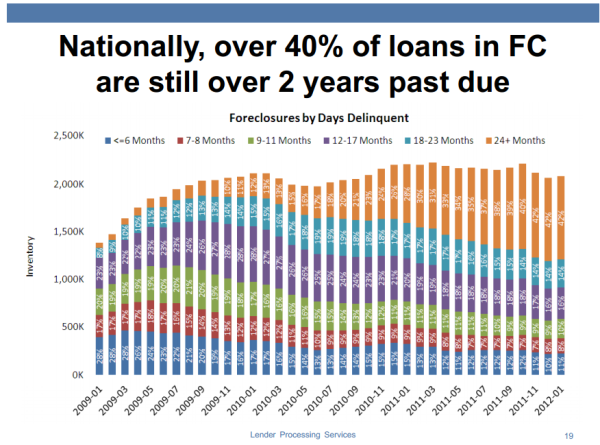
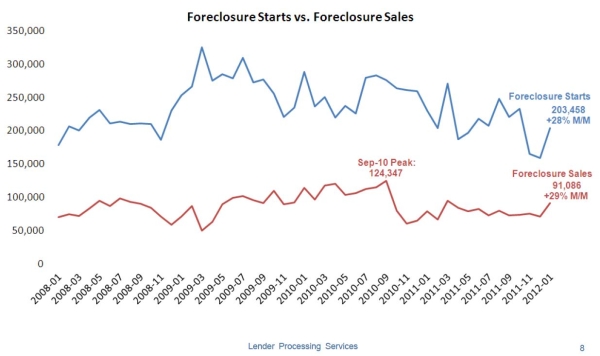
Will 2012 begin the unclogging of 6,000,000 distressed properties? Over 40 percent of the 2 million active foreclosures stand with no payment in over two years and some with three years and more. Foreclosure starts surge 28 percent in last month of data. Mid-tier markets in Los Angeles and Orange County contract severely in 2011. - Doctor Housing Bubble.com - March 8, 2012 - The housing market is clogged like backed up plumbing in an old building.  The shadow inventory is still very present even though visible inventory declined last year.  It seems like we are diving back into the rabbit hole where information is disguised and bad news is spun as being good.  Take for example the number of homes actively in foreclosure.  Early in 2009 we had roughly 2,000,000 homes actively in foreclosure.  The number today?  2,000,000.  The Catch 22 of the giant bank bailouts and financial shell game was the bet (hope) that housing prices would have gone back up after five years especially with trillions of dollars funneled into the banking sector.  I mean what can go wrong when you trust banks with housing right?  The reality is sinking in that home prices are going nowhere but down unless household incomes rise and that is why we saw foreclosure starts surge last month.  The shadow inventory is coming online and that means lower prices.  Don’t think this is a shell game?  Over 40 percent of the 2,000,000 foreclosures have not had a payment in two years.  This isn’t even factoring in the 4 million delinquent loans that are working their way into the REO side of the equation.


No. 414: Hyperinflation Special Report 2012 - U.S. Hyperinflationary Great Depression Moves Ever Closer - U.S. Government and the Federal Reserve Effectively Have Destroyed - Global Confidence in the U.S. Dollar - Systemic-Solvency and Economic Crises Have Not Abated - Precursors to Ultimate Dollar Disaster Are in Place;2014 Remains the Outside Timing for Same - Shadow Government Stats.com - January 25, 2012 - Hyperinflation 2012 is the fifth in a series of related writings going back to 2006.  It updates and replaces the Hyperinflation Special Report (2011) of March 15, 2011, which preceded: the U.S. government’s demonstration of a lack of political will to address the country’s long-range insolvency; the downgrade of the “AAA” rating of U.S. Treasury securities; an ensuing U.S. dollar panic, dollar support operations and extremely unstable U.S. and global financial markets; a temporary shift in market focus to Euro-era issues; and growing recognition of the ongoing and deepening economic and systemic-solvency crises.  Nonetheless, the outlook has changed little.  With the passage of 10 months since the last report (updated circumstances have been covered regularly in weekly Commentaries), events just have continued to move this pending ultimate financial crisis into much closer time proximity.    


U.S. Still Down 6 Million Jobs - Smart Money.com - Sarah Morgan - March 9, 2012
- ...The economy added 227,000 jobs in February, more than the 204,000 economists expected, the Labor Department reported this morning. The unemployment rate remained unchanged at 8.3% from last month. But while the economy has added more than 200,000 jobs for three straight months, the damage to employment done by the Great Recession is still far from repaired.

Between December 2007, when the recession officially started, and February 2010, when the Labor Department’s reports show employment hit bottom, the economy lost more than eight million jobs. Between then and now, we’ve added back more than two million jobs. With that big of a gap yet to fill, it’s extremely unlikely the unemployment rate will fall to a more “normal,” pre-crisis level of 6% by the end of this year, says Robert Johnson, the associate director of economic analysis at Morningstar. A rate below 8% — last seen in January 2009 — is possible by the end of the year, however, Johnson says...


U.S. Unemployment Up in February  - Underemployment is 19.1%, up from 18.7% in January - Gallup -  Dennis Jacobe, Chief Economist - March 8, 2012 - U.S. unemployment, as measured by Gallup without seasonal adjustment, increased to 9.1% in February from 8.6% in January and 8.5% in December. The 0.5-percentage-point increase in February compared with January is the largest such month-to-month change Gallup has recorded in its not-seasonally adjusted measure since December 2010, when the rate rose 0.8 points to 9.6% from 8.8% in November. A year ago, Gallup recorded a February increase of 0.4 percentage points, to 10.3% from 9.9% in January 2011.           In addition to the 9.1% of U.S. workers who are unemployed, 10.0% are working part time but want full-time work. This percentage is similar to the 10.1% in January, but is higher than the 9.6% of February 2011.


Bank of America In Trouble? - Rolling Stone.com - Matt Taibbi - March 2, 2012 - ...It’s a very bad sign that a bank is in a desperate cash crunch when it tries repeatedly to gouge its customers. David Trainer, an analyst for Market Watch, a WSJ publication, wrote that the new fees are a sign of series trouble at BAC. He writes:

In my opinion, there are four actions taken by financial services that signal the company is headed to serious trouble.
1. Management shake-up and major layoffs - lots of layoffs over the past year

2. Exploiting accounting rules to boost earnings - SFAS 159

3. Drawing down reserves to boost earnings: to the tune of $13.3 billion in 2011 and 2012

4. Bilking customers with new fees: tried it before and trying it again

Bank of America has taken all four steps. Bilking customers with new fees is a desperate measure of last resort because it requires exploiting the one asset the bank has left, namely its customers.


Gerald Celente on Goldseek Radio - March 9, 2012