I would like to tell you about my dealings with my electric bill over the last several months. It might serve to teach you a valuable lesson about dealing with the electric company. When I got my bill at the end of January, I found it to be extraordinarily high for the amount of usage that I felt was taking place.
That bill was a little bit over $150. As I have told you over the past year, my life has changed substantially. My grandmother lived in this house with me since I bought it in in late 2005. She passed away on August 6 of last year. She moved out at the beginning of June into a Nursing Home where she passed away two months later. I agreed a few years ago to let my grandmother keep the house any temperature that she wanted and agreed to let her use the electricity in any manner that she wanted, because she told me that she was willing to pay the electric bill. She was here all the time, and I work and am gone just like any average person would be from their home.
When we moved into the house. I was talked into having the level payment plan by Duke Energy. In September 2005, when we received our first bill, that level payment with $75 a month. By last year that payment had grown to over $150 per month. I constantly told my grandmother that her usage of electricity was going come back to bite me in my (you know where) and in the end I was right. My grandmother liked to keep the temperature at 75° in the Winter time and that 70° in the Summer. Well, you know what that can do to a power bill. She only paid attention to that level payment cost and didn't look at what the real kilowatt usage was every month and what the payment would be if we were paying a regular bill. There were months in the Winter when our power bill, would've been $200 a month under a regular bill.
When my grandmother moved out, I switched back to the regular payment system, and it reduced my cost drastically. My power bill has gone from being $150 per month to where it is substantially less than $100 per month. In October, the bill was a little bit more than $60, because no heating or air conditioning was used.
I've had to be frugal about how I budget my money over the last several years. I'm not making a killing. Over the winter, I kept one room at 70° and the rest of the house basically went unheated except for my main bathroom. I didn't use my heat pump at all. At the end of January, I noticed that my power bill was a little bit over $150, and I thought this was a little exorbitant for the lifestyle in which I've been leading. Frankly, I was wondering how the power bill could be this high. At the end of February, I received the next power bill, which showed that my bill had dropped to just over $51. Then, at the end of March, I received a bill that showed a little over $11.
When I received the bill at the end of February, I thought that they had misread the meter in January and the bill was balancing out. When I received the bill at the end of March I knew that something was wrong, but I really didn't do anything about it and figured it would all get taken care of. Well it did, but not in a positive way.
At the end of April, a couple of guys who I assumed worked for the power company came by and asked if I had noticed that my meter had stopped. I told him that I had noticed that the power bill had wildly fluctuated over the last few months and I figured something was wrong, but I hadn't looked at my power meter. How many people do look at their power meter on regular basis? That day they changed the power meter.
A week later I checked out my bill on the Internet and it showed over a $400 charge. I immediately called Duke Energy and asked what was up with this. They told me under North Carolina regulations that they can go back to the past year, and extrapolate and estimate your bill for the six-month period prior to the current month of the previous year. This blew my mind. I had never heard of this. Have you ever heard of this?
I explained to the billing representative at Duke Energy my situation and it basically fell on deaf ears, because the regulations in the State of North Carolina allow them to do this and there's basically nothing that you can do about it. I'm not one that cusses out operators or Managers over a telephone, but I did give them an earful. This just does not make any sense. If you remember last year, it was a cold winter. Not only that, but my grandmother was living here and our priority was her comfort. She was 96 years old, and you aren't going to tell some 96-year-old lady that she had to be uncomfortable for the sake of something that I didn't know existed or would come to bear in the future. I told the people with Duke Energy that they were comparing apples to oranges, and they agreed to reduce my bill by 15%, but in the end this is going to take $200 out of my pocket for energy that I never consumed.
I am basically having to pay $200 extra, because their equipment broke. I told the account manager the other day that I was being penalized because their equipment broke. She told me that I wasn't being penalized... that I wouldn't have to make any late payments and if I need to that I can go on a payment plan and yada yada yada; but she completely misses the point. If I have to pay for energy that I didn't consume, then I'm being penalized. There are no two ways about it. And my goal is to stay out of debt as much as possible, not make payments on extorted robbery. And then she pointed out about the regulations and said that Duke Energy had nothing to do with those regulations. They are regulations set up by the Utilities Commission. Duke's lobbyists, I guarantee, are the people who got that regulation passed and implemented; so the people with Duke Energy are fully accountable for this. The Utilities Commission, just like all of the other commissions, represent business interests and not the people.
And I never really thought that I was getting away with anything. I knew that in some way that I was going to have to pay for the energy that had been consumed, when I received that bill in March, but this was totally over the top. I have no choice but to pay the bill, if I want to maintain my credit rating and use electricity in my house. What a wonderful world we live in with all of these monopolies where they have you over a barrel.
I just wanted to convey this issue, so that the people who read this information will know that this can happen to them. Duke Energy's equipment breaks, and you're going to pay for it one way or another, whether you owe it or not. If you notice your meter has broken, then you better get your monies' worth.
I don't know what kind of a good lesson was learned here. I guess to try and figure out a way to get off the electric grid as soon as possible. When something like this happens, you feel like you've been robbed. If I was making a bunch of money, and not having to live as frugally as I have been, I know that this wouldn't bother me as much as it does. But when you're doing everything that you can to survive and you keep getting kicked while you're down, it sure is frustrating.
Peace be with you all and I hope that nothing like this ever happens to any of you.

Friday, May 25, 2012
Wednesday, May 23, 2012
Chris Washburn's Comeback story from WGHP News - Channel 8 - High Point
The following is a story that was presented about Chris Washburn on High Point Channel 8 WGHP News. Since most of us in Hickory don't get Channel 8 on our televisions, I thought I would make this available here. I think that everyone in our community is glad to see that Chris is doing good things with his life. It is also good to see what he has done with that former Tasty Fried Chicken. We should all help support his store.
Chris is showing people that as low as a person can get, they can always redeem themselves. It is always hard to give up the thoughts of what could have been with Chris, but in the end it is Chris's life, not our own, and it is about what Chris had to go through. Basketball is just a sport. Chris has made a comeback in the biggest sport of all - LIFE!!! This is an inspirational story.
Chris is showing people that as low as a person can get, they can always redeem themselves. It is always hard to give up the thoughts of what could have been with Chris, but in the end it is Chris's life, not our own, and it is about what Chris had to go through. Basketball is just a sport. Chris has made a comeback in the biggest sport of all - LIFE!!! This is an inspirational story.

Tuesday, May 22, 2012
Ward Specific Voting - You can Be the Difference!!!
The numbers are getting close on having enough signatures to bring about a special election, which would allow the community to have a say in how the City Council is elected. That process was not allowed to occur when the current system was manipulated into existence by the City Council in 1967 and implemented in 1970. This change would directly impact how Council Members represent their ward. We think it would positively impact the big picture and city wide governance.
What is clear from the issues that we have seen over the last several years is that the current system does not encourage accountability. What it does is encourage Bloc Voting constituencies that allow certain wards to dictate policy in other wards and we believe that it causes ambivalence towards development in certain wards thereby harming the viability of the City as a whole. And as Hickory goes so goes the Metro regional area.
So if you want to do something that will create a major impact on the area, then print out and fill out the petition linked below. Once you have done this contact me at hickoryhound@gmail.com and tell me where I can pick up this signed petition or dial 828-612-8448 so that we can move forward. We are getting close to having enough signatures and your signature could be the one that puts us over the top.
You can be the person that makes a difference in our future by doing this today. You can help bring government back to the people. Peace be with you and may this cause be blessed.
Will you print out and sign the attached petition and mail back to us? It will take you less than 5 minutes and will make a HUGE improvement in future elections.
Click here to download the petition.
Other registered voters in your house and neighborhood can also sign the petition. If you prefer, I can mail you a petition and a stamped envelope to return it in - just reply to my email (cjane@rayandcjane.com) with your request.
I know you believe in fair and representative government; if you have questions about how the true ward system will make that happen, please call me any time at 828-612-8448.
1961 -- A lesson in Hickory's History
1967 - How we got where we are today
The History of At-Large voting in Hickory - The HDR articles and Council Minutes Documents
Hal Row's First Talk - CEG discussion about Ward Specific Voting - The Interview
Help Bring Fair Representation Back to the City of Hickory
Mayor Wright - Hal Row - Ward Specific Elections
What is clear from the issues that we have seen over the last several years is that the current system does not encourage accountability. What it does is encourage Bloc Voting constituencies that allow certain wards to dictate policy in other wards and we believe that it causes ambivalence towards development in certain wards thereby harming the viability of the City as a whole. And as Hickory goes so goes the Metro regional area.
So if you want to do something that will create a major impact on the area, then print out and fill out the petition linked below. Once you have done this contact me at hickoryhound@gmail.com and tell me where I can pick up this signed petition or dial 828-612-8448 so that we can move forward. We are getting close to having enough signatures and your signature could be the one that puts us over the top.
You can be the person that makes a difference in our future by doing this today. You can help bring government back to the people. Peace be with you and may this cause be blessed.
- In a true ward system, voters in each ward choose their own representative; it’s more democratic because local voters have a bigger say in who represents their wards.
- A true ward system allows more citizens to consider running for office because it is less expensive to run an election in one ward than to run city-wide; we’ll get some new perspectives and fresh ideas on city council.
- A true ward system makes representatives more accountable because they live and work in the same community where their constituents live so they have daily contact with their voters.
- True ward system elections are less expensive for taxpayers because only half the polls have to be open each election year.
Will you print out and sign the attached petition and mail back to us? It will take you less than 5 minutes and will make a HUGE improvement in future elections.
Click here to download the petition.
Other registered voters in your house and neighborhood can also sign the petition. If you prefer, I can mail you a petition and a stamped envelope to return it in - just reply to my email (cjane@rayandcjane.com) with your request.
I know you believe in fair and representative government; if you have questions about how the true ward system will make that happen, please call me any time at 828-612-8448.
1961 -- A lesson in Hickory's History
1967 - How we got where we are today
The History of At-Large voting in Hickory - The HDR articles and Council Minutes Documents
Hal Row's First Talk - CEG discussion about Ward Specific Voting - The Interview
Help Bring Fair Representation Back to the City of Hickory
Mayor Wright - Hal Row - Ward Specific Elections
Sunday, May 20, 2012
Economic Stories of Relevance in Today's World -- May 20, 2012
$12,984--Increase in Debt Per Household Since First 2011 Bipartisan Spending Deal - CNS News.com - Terence P. Jeffrey - May 18, 2012 - The White House and the congressional leaders of both parties in Congress have begun maneuvering this week over the issue of the federal debt and what to do when the government hits the latest statutory limit on that debt--$16.394 trillion—which Congress and the president agreed to when they cut a deal on the debt limit last August. The federal debt is currently $15.709 trillion, or about $685 billion below the limit. The first spending deal the White House and leaders of both parties in Congress made last year was on March 2. On that day, the president signed a continuing resolution to keep the government funded past March 4, when the previous continuing resolution, passed by a lame-duck Congress in late 2010, expired.
John Williams: The Real Unemployment Rate: 22% – Not 8.1% - The coming fiscal cliff: hyperinflation on track for 2014 - Lew Rockwell.com - James J. Puplava - May 16, 2012 - JIM: Joining me on the program today is John Williams of Shadow Government Statistics. And John, before we get into a real big issue that’s going to hit the economy January 2013, I want to talk about the front page of your website. And you have two graphs that are available publicly and one is the unemployment rate where you have U3, U6 and then SGS, which is your own. Let’s talk about those numbers, what they mean for our listeners and the differences between them. [1:11]
JOHN: Sure. I’ve been a consulting economist for 30 years. What I’ve found over the decades is that the government’s reporting has moved further and further away from common experience, and really, the average guy has got a pretty good sense of what’s going on. If you feel the economy is not as strong as the government is saying or that inflation might be higher than what they’re reporting, you’re most likely right because you’re dealing with the real world. The numbers use to deal much closer to real world experience. And with the unemployment number, if you, let’s say, went around the entire country and asked everyone whether he or she was unemployed, you’d get an immediate answer. Most people have a pretty strong opinion as to what’s up, they have a job; they know what’s going on. But if you put all those numbers together, you’d come up with a much higher unemployment rate than the government reports, or at least the headline government number to date. So that’s all due to definition. In order to be counted in the headline unemployment rate – and keep in mind, the government actually publishes six levels of unemployment. The third level they call U3 is the headline number – you have to obviously be out of work and willing and able to take a job, but you have to have actively looked for work in the last four weeks. There are people who’ve stopped looking for work after a period of time when there are just no jobs to be had, yet they’d take a job if it were available, and they otherwise consider themselves unemployed. They want a job; they are willing and able to work. And again, they’d take it as soon as it was offered. If you haven't been looking in the last four weeks, the government will count you as a discouraged worker so long as you've looked for work in the last year. If you haven't actively looked for work in the last year, they don’t count you at all. Before 1994, anybody who was a discouraged worker, irrespective of the period of time, was counted as a discouraged worker. So that where you have the U3 unemployment rate at, I believe it’s 8.2% in March, the government’s broadest number U6 (which includes what I call the short term discouraged workers, those who have given up looking for work, but not for more than a year) and also includes people who work part-time for economic reasons (they can’t get a full-time job, they want a full-time job but you know, no full-time job is available) that’s running up somewhat over 14%. And what I do is I add to that my estimate of the longer term discouraged workers – those who have been discouraged more than a year. That puts you up over 22%. What happens here is the people who are unemployed roll out of the U3 level; they become discouraged because there are no jobs to be had, and so they go into the U6 level. And after a year, they roll out of the U6 level in terms of going into another world that the government does not count. I still estimate them, so my number is broader than the government’s number. So when you see the unemployment rate dropping, yet the broader measures are rising or staying at near historic levels, you do not have an economic recovery and that’s what we’re showing. [4:26]
There Are 100 Million Working Age Americans That Do Not Have Jobs - The Economic Collapse Blog - The unemployment crisis in America is much worse than you are being told. Did you know that there are 100 million working age Americans that do not get up in the morning and go to work? No wonder why it seems like there are so many people that do not have jobs! According to the federal government, there are 12.6 million working age Americans that are considered to be "officially" unemployed, but there are another 87.8 million working age Americans that are not working either. The federal government considers those Americans to be "not in the labor force" so they are not included in the unemployment rate. In fact, this is one of the key ways that the government manipulates the unemployment numbers. The Obama administration would have us believe that the unemployment rate is going down and that that since the start of the last recession about as many Americans have left the labor force as we saw during the entire decades of the 1980s and 1990s combined. Of course that is a bunch of nonsense, but that is what the Obama administration would have us believe. The truth is that the percentage of working age Americans that are employed is just about the same right now as it was two years ago. It was incredibly difficult to get a job back then and it is incredibly difficult to get a job right now. So don't believe the hype that things are getting much better. If you still do have a good job, you might want to hold on to it tightly, because there is not much hope that things are going to improve significantly any time soon. The first chart that I have posted below shows the total number of "officially" unemployed workers in America. According to the Federal Reserve, that number is currently 12,673,000. This chart makes it look like the employment picture in America is getting significantly better....

But if you dig deeper into the numbers you quickly see that this is not true. A lot of those workers that were formerly classified as "unemployed" have now been moved into the "not in labor force" category. Since the start of the last recession, the number of Americans not in the labor force has risen by more than 8 million according to the Obama administration. The total number of working age Americans not in the labor force now stands at 87,897,000....

So when you add 12,673,000 and 87,897,000, you get a total of 100,570,000 working age Americans that do not have jobs. Yes, there are certainly millions upon millions of working age Americans that do not have jobs and that do not want jobs. But you have to be delusional to believe that there are nearly 88 million working age Americans that do not have jobs and that do not want jobs.
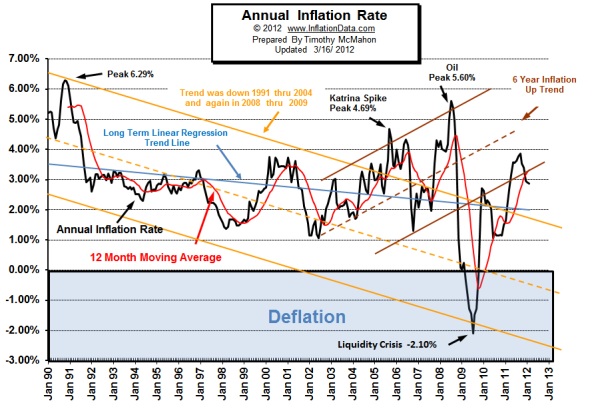
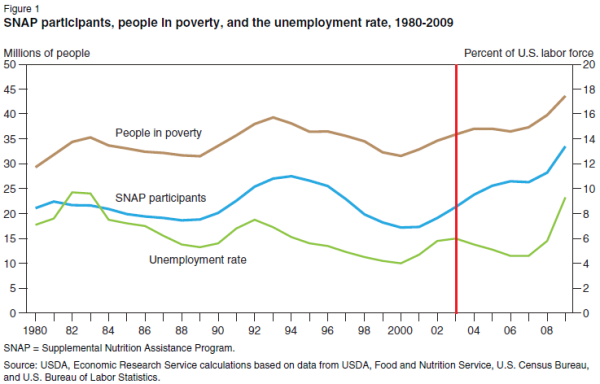
The wrecking ball of hidden inflation and Fed based strategies – food inflation far outpacing overall inflation and eating away at the purchasing power of 46,000,000 Americans on food stamps. - My Budget 360.com - The Federal Reserve has openly called for a steady growth of inflation. This almost dogmatic view on inflation is problematic because it is detached to the lack of wage growth being experienced by working and middle class families. What you do not hear articulated from the Fed is that they would like to encourage wage inflation as well. The inflation growth is really a shadow bailout of the banking sector in our economy that still requires billions and billions of dollars for horrible bets and poorly placed gambles. If the beat of inflation marches on, these debts can be washed away simply because purchasing power is lost moving forward. Yet this is bad policy for the vast majority of Americans. Inflation has crept into the daily lives of Americans because of this policy. Food prices have increased steadily while energy remains expensive. The cost to go to college still continues to increase in spite of a bubble in student debt. Inflation is a double-edged sword and the Fed is aggressively pursuing this option largely to aid their banking allies.
Inflation is already here for working and middle class Americans
Inflation is already hitting the wallets of most Americans. - After the liquidity crisis and trillions of dollars infused into the system, inflation is now on an upward march:


Since 2010 the inflation rate in food has far outpaced the rate of inflation overall. With so many Americans struggling to get by this is being felt in many ways on a daily basis. Anyone shopping at the store realizes how much more expensive food items have become. You also see disinflation where you pay the same price but get less because of creative packaging:


JPMorgan’s Trading Loss Is Said to Rise at Least 50% - Dealbook.com - NELSON D. SCHWARTZ and JESSICA SILVER-GREENBERG - May 16, 2012 - The trading losses suffered by JPMorgan Chase have surged in recent days, surpassing the bank’s initial $2 billion estimate by at least $1 billion, according to people with knowledge of the losses. When Jamie Dimon, JPMorgan’s chief executive, announced the losses last Thursday, he indicated they could double within the next few quarters. But that process has been compressed into four trading days as hedge funds and other investors take advantage of JPMorgan’s distress, fueling faster deterioration in the underlying credit market positions held by the bank. A spokeswoman for the bank declined to comment, although Mr. Dimon has said the total paper trading losses will be volatile depending on day-to-day market fluctuations.
JPMorgan unit has $100bn of risky bonds - Financial Times of London - Sam Jones in London and Tracy Alloway and Tom Braithwaite in New York - May 18, 2012 - The unit at the centre of JPMorgan Chase’s $2bn trading loss has built up positions totalling more than $100bn in asset-backed securities and structured products – the complex, risky bonds at the centre of the financial crisis in 2008. These holdings are in addition to those in credit derivatives which led to the losses and have mired the bank in regulatory investigations and criticism. The unit, the chief investment office (CIO), has been the biggest buyer of European mortgage-backed bonds and other complex debt securities such as collateralised loan obligations in all markets for three years, more than a dozen senior traders and credit experts have told the Financial Times. The bank has said its derivative activities were intended primarily to help balance risks on its overall balance sheet, but the revelation that it has built up other large, risky positions is likely to raise further questions about the CIO’s remit.
The Obama Economy Is Wrecking NASCAR - According to a new study - The Weekly Standard - Michael Warren - May 15, 2012 - The National Association for Stock Car Auto Racing (NASCAR) has been considered America’s fastest growing sport, quickly becoming a national phenomenon. But a new economic study shows even NASCAR’s powerful engines haven’t been able to keep up with the Obama-era economy. The study, from the pro-market think tank Public Notice and Race Fans 4 Freedom, finds that the economic downturn of the last several years has directly affected how NASCAR fans watch and enjoy their sport. Since 2009, race attendance per year has fallen below 4 million people, and the number has been declining severely as the unemployment rate has skyrocketed. The cost of attending—with higher gas prices, less disposable income, and diminished financial security—has increased. According to the study, the value of the sport, too, is threatened by the poor economy, with the stock prices of racing team companies plummeting in the last five years and sponsors pulling back on funding cars.
Paul Krugman admits to the Depression - He is a Democrat Party extremist, but the message is clear that we aren't in a recovery. We are in a Depression. He sloshes through the interview with Democrat Dogma and ideology, but his viewpoint is worthwhile. Krugman is quick to cut Obama slack and call Republicans liars and. Folks, we have to meet somewhere in the middle. Say no to Austerity. Say no to Cronyism. Say yes to targeted spending on infrastructure and human capital and rein in "Free for All" trade and the Gambleholic Banksters.
John Williams: The Real Unemployment Rate: 22% – Not 8.1% - The coming fiscal cliff: hyperinflation on track for 2014 - Lew Rockwell.com - James J. Puplava - May 16, 2012 - JIM: Joining me on the program today is John Williams of Shadow Government Statistics. And John, before we get into a real big issue that’s going to hit the economy January 2013, I want to talk about the front page of your website. And you have two graphs that are available publicly and one is the unemployment rate where you have U3, U6 and then SGS, which is your own. Let’s talk about those numbers, what they mean for our listeners and the differences between them. [1:11]
JOHN: Sure. I’ve been a consulting economist for 30 years. What I’ve found over the decades is that the government’s reporting has moved further and further away from common experience, and really, the average guy has got a pretty good sense of what’s going on. If you feel the economy is not as strong as the government is saying or that inflation might be higher than what they’re reporting, you’re most likely right because you’re dealing with the real world. The numbers use to deal much closer to real world experience. And with the unemployment number, if you, let’s say, went around the entire country and asked everyone whether he or she was unemployed, you’d get an immediate answer. Most people have a pretty strong opinion as to what’s up, they have a job; they know what’s going on. But if you put all those numbers together, you’d come up with a much higher unemployment rate than the government reports, or at least the headline government number to date. So that’s all due to definition. In order to be counted in the headline unemployment rate – and keep in mind, the government actually publishes six levels of unemployment. The third level they call U3 is the headline number – you have to obviously be out of work and willing and able to take a job, but you have to have actively looked for work in the last four weeks. There are people who’ve stopped looking for work after a period of time when there are just no jobs to be had, yet they’d take a job if it were available, and they otherwise consider themselves unemployed. They want a job; they are willing and able to work. And again, they’d take it as soon as it was offered. If you haven't been looking in the last four weeks, the government will count you as a discouraged worker so long as you've looked for work in the last year. If you haven't actively looked for work in the last year, they don’t count you at all. Before 1994, anybody who was a discouraged worker, irrespective of the period of time, was counted as a discouraged worker. So that where you have the U3 unemployment rate at, I believe it’s 8.2% in March, the government’s broadest number U6 (which includes what I call the short term discouraged workers, those who have given up looking for work, but not for more than a year) and also includes people who work part-time for economic reasons (they can’t get a full-time job, they want a full-time job but you know, no full-time job is available) that’s running up somewhat over 14%. And what I do is I add to that my estimate of the longer term discouraged workers – those who have been discouraged more than a year. That puts you up over 22%. What happens here is the people who are unemployed roll out of the U3 level; they become discouraged because there are no jobs to be had, and so they go into the U6 level. And after a year, they roll out of the U6 level in terms of going into another world that the government does not count. I still estimate them, so my number is broader than the government’s number. So when you see the unemployment rate dropping, yet the broader measures are rising or staying at near historic levels, you do not have an economic recovery and that’s what we’re showing. [4:26]
There Are 100 Million Working Age Americans That Do Not Have Jobs - The Economic Collapse Blog - The unemployment crisis in America is much worse than you are being told. Did you know that there are 100 million working age Americans that do not get up in the morning and go to work? No wonder why it seems like there are so many people that do not have jobs! According to the federal government, there are 12.6 million working age Americans that are considered to be "officially" unemployed, but there are another 87.8 million working age Americans that are not working either. The federal government considers those Americans to be "not in the labor force" so they are not included in the unemployment rate. In fact, this is one of the key ways that the government manipulates the unemployment numbers. The Obama administration would have us believe that the unemployment rate is going down and that that since the start of the last recession about as many Americans have left the labor force as we saw during the entire decades of the 1980s and 1990s combined. Of course that is a bunch of nonsense, but that is what the Obama administration would have us believe. The truth is that the percentage of working age Americans that are employed is just about the same right now as it was two years ago. It was incredibly difficult to get a job back then and it is incredibly difficult to get a job right now. So don't believe the hype that things are getting much better. If you still do have a good job, you might want to hold on to it tightly, because there is not much hope that things are going to improve significantly any time soon. The first chart that I have posted below shows the total number of "officially" unemployed workers in America. According to the Federal Reserve, that number is currently 12,673,000. This chart makes it look like the employment picture in America is getting significantly better....
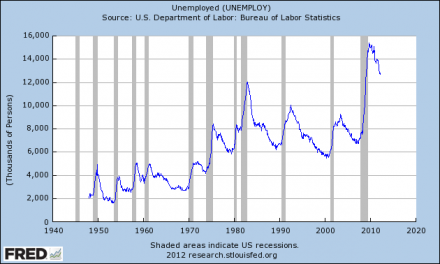
But if you dig deeper into the numbers you quickly see that this is not true. A lot of those workers that were formerly classified as "unemployed" have now been moved into the "not in labor force" category. Since the start of the last recession, the number of Americans not in the labor force has risen by more than 8 million according to the Obama administration. The total number of working age Americans not in the labor force now stands at 87,897,000....
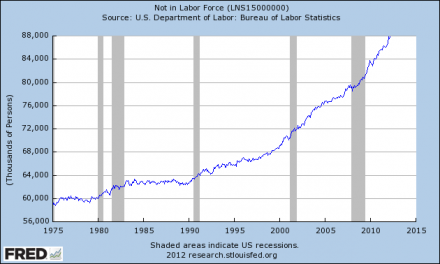
So when you add 12,673,000 and 87,897,000, you get a total of 100,570,000 working age Americans that do not have jobs. Yes, there are certainly millions upon millions of working age Americans that do not have jobs and that do not want jobs. But you have to be delusional to believe that there are nearly 88 million working age Americans that do not have jobs and that do not want jobs.
The wrecking ball of hidden inflation and Fed based strategies – food inflation far outpacing overall inflation and eating away at the purchasing power of 46,000,000 Americans on food stamps. - My Budget 360.com - The Federal Reserve has openly called for a steady growth of inflation. This almost dogmatic view on inflation is problematic because it is detached to the lack of wage growth being experienced by working and middle class families. What you do not hear articulated from the Fed is that they would like to encourage wage inflation as well. The inflation growth is really a shadow bailout of the banking sector in our economy that still requires billions and billions of dollars for horrible bets and poorly placed gambles. If the beat of inflation marches on, these debts can be washed away simply because purchasing power is lost moving forward. Yet this is bad policy for the vast majority of Americans. Inflation has crept into the daily lives of Americans because of this policy. Food prices have increased steadily while energy remains expensive. The cost to go to college still continues to increase in spite of a bubble in student debt. Inflation is a double-edged sword and the Fed is aggressively pursuing this option largely to aid their banking allies.
Inflation is already here for working and middle class Americans
Inflation is already hitting the wallets of most Americans. - After the liquidity crisis and trillions of dollars infused into the system, inflation is now on an upward march:
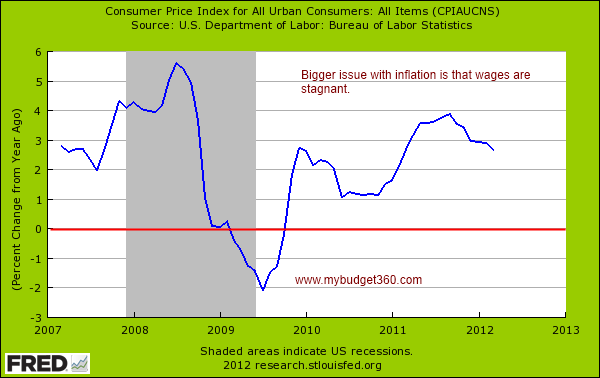
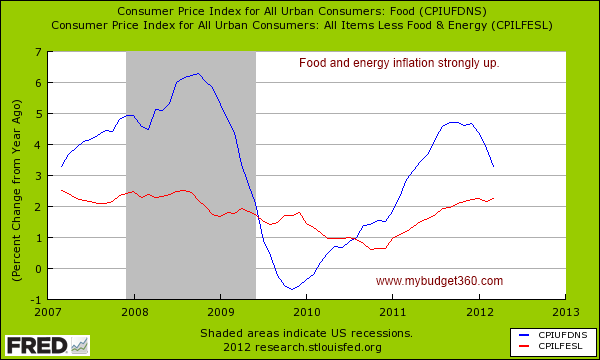
Since 2010 the inflation rate in food has far outpaced the rate of inflation overall. With so many Americans struggling to get by this is being felt in many ways on a daily basis. Anyone shopping at the store realizes how much more expensive food items have become. You also see disinflation where you pay the same price but get less because of creative packaging:

“(Country Consultant) Tropicana orange juice: 64 oz. container is now 59 oz. – a 7.8 percent reduction.
Ivory dish detergent: 30 oz. bottle is now 24 oz. – 20 percent reduction
Kraft American cheese: 24 slice package now holds 22 slices – 8.3 percent reduction
Scott toilet tissue: 115.2 sq. ft. now 104.8 sq. ft. – 9 percent reduction
Chicken of the Sea salmon: 3 oz. can now 2.6 oz. – 13.3 percent reduction”
JPMorgan’s Trading Loss Is Said to Rise at Least 50% - Dealbook.com - NELSON D. SCHWARTZ and JESSICA SILVER-GREENBERG - May 16, 2012 - The trading losses suffered by JPMorgan Chase have surged in recent days, surpassing the bank’s initial $2 billion estimate by at least $1 billion, according to people with knowledge of the losses. When Jamie Dimon, JPMorgan’s chief executive, announced the losses last Thursday, he indicated they could double within the next few quarters. But that process has been compressed into four trading days as hedge funds and other investors take advantage of JPMorgan’s distress, fueling faster deterioration in the underlying credit market positions held by the bank. A spokeswoman for the bank declined to comment, although Mr. Dimon has said the total paper trading losses will be volatile depending on day-to-day market fluctuations.
JPMorgan unit has $100bn of risky bonds - Financial Times of London - Sam Jones in London and Tracy Alloway and Tom Braithwaite in New York - May 18, 2012 - The unit at the centre of JPMorgan Chase’s $2bn trading loss has built up positions totalling more than $100bn in asset-backed securities and structured products – the complex, risky bonds at the centre of the financial crisis in 2008. These holdings are in addition to those in credit derivatives which led to the losses and have mired the bank in regulatory investigations and criticism. The unit, the chief investment office (CIO), has been the biggest buyer of European mortgage-backed bonds and other complex debt securities such as collateralised loan obligations in all markets for three years, more than a dozen senior traders and credit experts have told the Financial Times. The bank has said its derivative activities were intended primarily to help balance risks on its overall balance sheet, but the revelation that it has built up other large, risky positions is likely to raise further questions about the CIO’s remit.
The Obama Economy Is Wrecking NASCAR - According to a new study - The Weekly Standard - Michael Warren - May 15, 2012 - The National Association for Stock Car Auto Racing (NASCAR) has been considered America’s fastest growing sport, quickly becoming a national phenomenon. But a new economic study shows even NASCAR’s powerful engines haven’t been able to keep up with the Obama-era economy. The study, from the pro-market think tank Public Notice and Race Fans 4 Freedom, finds that the economic downturn of the last several years has directly affected how NASCAR fans watch and enjoy their sport. Since 2009, race attendance per year has fallen below 4 million people, and the number has been declining severely as the unemployment rate has skyrocketed. The cost of attending—with higher gas prices, less disposable income, and diminished financial security—has increased. According to the study, the value of the sport, too, is threatened by the poor economy, with the stock prices of racing team companies plummeting in the last five years and sponsors pulling back on funding cars.
Paul Krugman admits to the Depression - He is a Democrat Party extremist, but the message is clear that we aren't in a recovery. We are in a Depression. He sloshes through the interview with Democrat Dogma and ideology, but his viewpoint is worthwhile. Krugman is quick to cut Obama slack and call Republicans liars and. Folks, we have to meet somewhere in the middle. Say no to Austerity. Say no to Cronyism. Say yes to targeted spending on infrastructure and human capital and rein in "Free for All" trade and the Gambleholic Banksters.
Saturday, May 19, 2012
The Millenium Dome - A lesson to be learned
(The Hound) : The following is what happens when projects are implemented in a closed process with decision making kept within bureaucratic structures. The process goes from an idea that hasn't been properly vetted to a project that has to be rethought and redeveloped on the fly to a process that revolves around political face saving, instead of the project itself. And it ends up costing a lot more than the initial estimates. A whole lot more in reassessed and unintended consequences and costs. This does not mean that the public doesn't want progress or to nitpick every project. It means that the public wants to be included in open and transparent processes. When Government includes the people in a forthright process you will still have a few detractors, but you will also have invested in legitimacy from the masses.
(From Wikipedia) - The Millennium Dome, colloquially referred to simply as The Dome, is the original name of a large dome-shaped building, originally used to house the Millennium Experience, a major exhibition celebrating the beginning of the third millennium. Located on the Greenwich Peninsula in South East London, England, the exhibition was open to the public from 1 January to 31 December 2000. The project and exhibition was the subject of considerable political controversy as it failed to attract the number of visitors anticipated, with recurring financial problems. All of the original exhibition and associated complex has since been demolished. The dome still exists, and it is now a key exterior feature of The O2. The Prime Meridian passes the western edge of the Dome and the nearest London Underground station is North Greenwich on the Jubilee Line.
Dome disaster has swallowed millions - The Telegraph - September 6, 2000
Millennium Dome - Politics.uk.com
What Should Have Gone Into the Millennium Dome? British History - Wall Street Journal - Iain Martin - August 27, 2010
5 Ways Process Is Killing Your Productivity - FastCompany.com - Lisa Bodell May 15, 2012
Here are five ways process can kill production:
When people’s jobs depend on meeting metrics and maintaining the status quo, can you fault them for their reluctance to expend any energy toward creation and invention?
(From Wikipedia) - The Millennium Dome, colloquially referred to simply as The Dome, is the original name of a large dome-shaped building, originally used to house the Millennium Experience, a major exhibition celebrating the beginning of the third millennium. Located on the Greenwich Peninsula in South East London, England, the exhibition was open to the public from 1 January to 31 December 2000. The project and exhibition was the subject of considerable political controversy as it failed to attract the number of visitors anticipated, with recurring financial problems. All of the original exhibition and associated complex has since been demolished. The dome still exists, and it is now a key exterior feature of The O2. The Prime Meridian passes the western edge of the Dome and the nearest London Underground station is North Greenwich on the Jubilee Line.
Dome disaster has swallowed millions - The Telegraph - September 6, 2000
Millennium Dome - Politics.uk.com
What Should Have Gone Into the Millennium Dome? British History - Wall Street Journal - Iain Martin - August 27, 2010
5 Ways Process Is Killing Your Productivity - FastCompany.com - Lisa Bodell May 15, 2012
Here are five ways process can kill production:
- Empowering with permission--but without action:It’s not empowering when people are given more responsibility, yet must still obtain an unreasonable number of approvals and sign-offs to get anything done. This signals a lack of trust.
- Leaders focused on process instead of people: In an effort to standardize and sanitize everything we do, nothing at work is personal anymore. Leaders look to processes, not people, to solve problems--and it doesn’t work. Where’s the inspiration, the vision? This signals a lack of humanity.
- Overdependence on meetings: “Collaborative” and “inclusive” are corporate buzzwords, but productive teamwork does not require meetings for every single action or decision. People become overwhelmed and ineffective when they are always stuck in meetings. This signals that politics have taken precedence over productivity.
- Lack of (clear) vision: Great companies need a grand vision and important goals. Too often, companies have vision or mission statements laden with jargon but devoid of meaning. This signals a lack of purpose.
- Management acts as judge, not jury: If the purpose of a meeting is to think, create, or build, management has to stop tearing people down when they propose new ideas or question the status quo. This signals a lack of perspective and openness.
When people’s jobs depend on meeting metrics and maintaining the status quo, can you fault them for their reluctance to expend any energy toward creation and invention?
Subscribe to:
Posts (Atom)